Buy prices and grading for second-hand goods
Decide what each grade promises, what you pay in each grade, and the questions that settle it. Publish them, and a website built on the public catalogue can show a seller your price before they come in. The online shop Talstok runs for you does not show buy prices.

From a seller’s question to your price
Set it up once. A website built on the public catalogue then answers sellers with your own grades and prices.
Write your grades
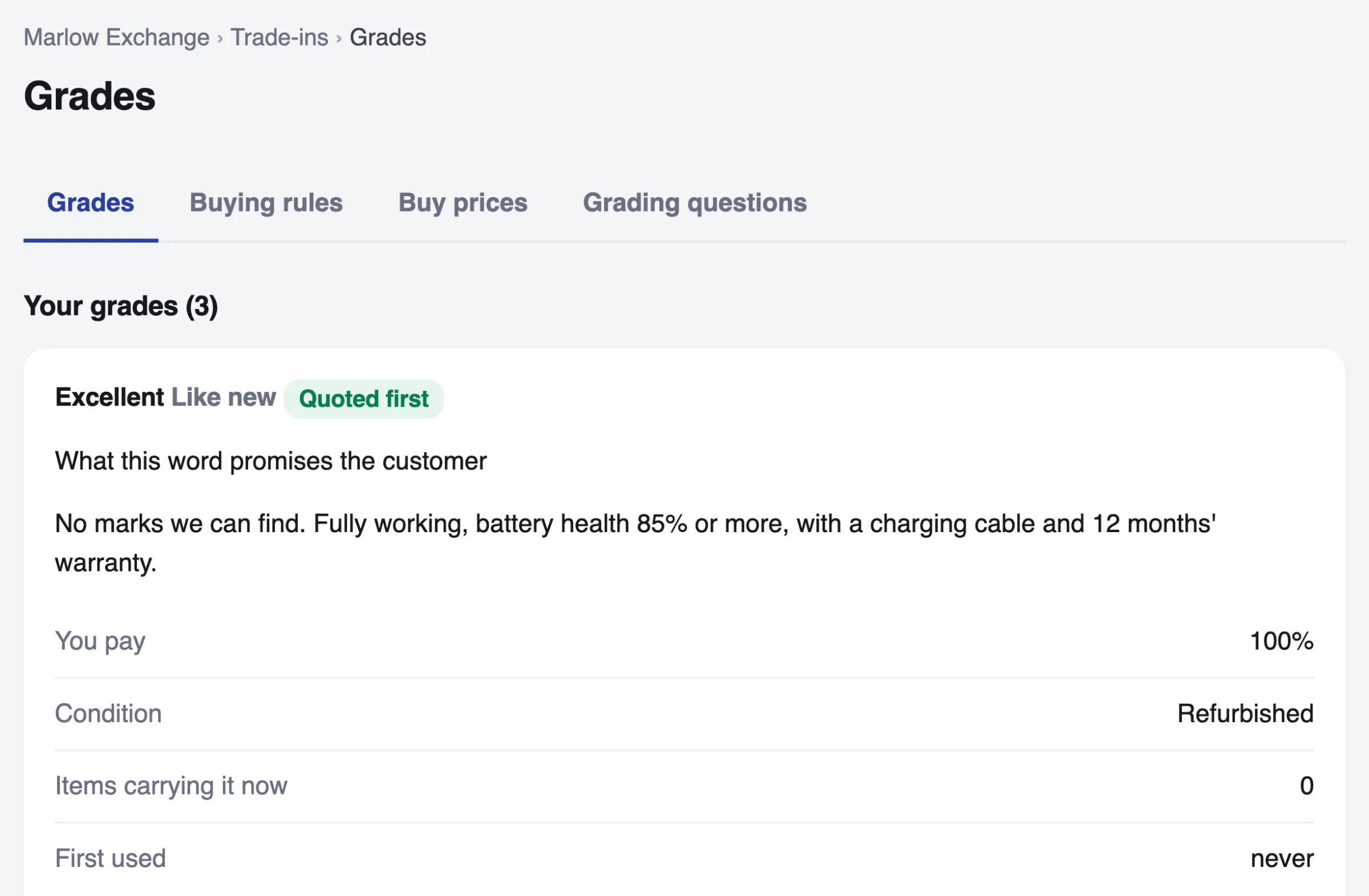
Best first, each with what it promises whoever buys the item from you.
Set what you pay
A cash price and a store credit price for each item in each grade, typed in or imported from a spreadsheet.
Write the questions
A set of questions whose answers decide the grade. Try answers in the preview, then publish.
Publish them
A website built on the public catalogue reads the grades, prices and questions, so a seller can describe the item and see your offer.
What else it does
Buying rules
Note the share of your selling price you pay in cash or in credit, and a lower share once you hold enough. Offers are not worked out from a rule yet: you type or import each buy price. A buy price above the rule’s “Ask me first above” figure is refused.
By weight
Set a buy price per gram or per millilitre, as well as per item.
The first quote
Choose which grade a website built on the public catalogue quotes first.
Drafts first
Grading questions stay a draft until you publish. A published set is kept, because people were graded under it.
Selling it on
Keep what you buy one by one, by serial number or IMEI, with its own grade, price, facts and photos.
Sold as itself
At the till, staff scan or pick the exact item. Online, tick “Customers choose the exact item” on a product, and the buyer picks the one in the photos and gets it.
A grade means what it says
Each grade carries a promise in your words. Once a grade is given to anything in your stock, its name and promise are fixed.
- Each grade records what you pay for it as a share of your best grade
- Mark a grade as new, refurbished, used or damaged
- Retire a grade without deleting it: items keep their grade and price
Not built yet
The buying side is part-built. A shop that buys over the counter today records the purchase outside the system.
Recording a purchase
Logging what you bought from a member of the public, with the seller’s details and an ID check, is not built yet.
Paying sellers
Paying a seller through the system is not built yet.
Store credit balances
You can quote a store credit price, but keeping a customer’s credit balance is not built yet.
The VAT margin book
The margin scheme’s stock book is not built yet. Keep it as you do now.
Questions about buying
Is there VAT on second-hand goods?
Usually yes, if you are VAT registered. HMRC’s VAT margin schemes let a dealer in eligible second-hand goods pay VAT on the difference between what they paid and what they sold for, instead of on the whole price, if they keep the records the scheme asks for. HMRC sets out the rules in its gov.uk guide, “VAT margin schemes”.
Talstok does not keep the margin scheme’s stock book yet.
Can a seller see what I would pay before they come in?
Yes, if your website is built on the public catalogue. It can read your buy prices, grades and grading questions and show a price for each item and grade. The online shop Talstok runs for you does not show buy prices.
Can I quote cash and store credit?
Yes. A buy price can have a cash figure, a store credit figure or both, and a website built on the public catalogue can show them. Keeping a customer’s store credit balance is not built yet.
Can I set buy prices by weight, such as for gold?
Yes. A buy price can be set per gram or per millilitre as well as per item. Recording the purchase itself, with the seller’s details and an ID check, is not built yet.
Is it only for phones?
No. Grades, options and questions are written in your own words, so they fit books, games, jewellery or tools as well as phones.
See it with your own products
A test shop is free. Nothing in it is real: no money moves, and it never emails a customer. You pay only once a shop takes real money.