In short. Stock control is one reliable count per item, a record of why it changed, and a rule for when to reorder. A stocktake checks the count against the shelf.
On this page
Too much stock ties up cash in things that are not selling. Too little, and a customer leaves without what they came in for. Stock control keeps a shop between the two, and it starts with one reliable number for each item.
The stock count
Every item you sell has a count. A sale takes from it and a delivery adds to it; a refund, a breakage or a theft changes it too. Good stock control records why each change happened as well as the new number, so that when the count is wrong you can find where it went wrong.
The count only works if every sale reaches it. A shop that sells at a counter and online needs both to take from the same count, or the last one in stock can be sold twice.
Methods of stock control
Stocktakes and cycle counts
A full stocktake counts everything at once. Many shops do one a year, often at the end of their financial year. A cycle count spreads the work out: a few lines each week, so every item is counted several times a year and the busiest lines most often.
The gap between the records and the shelf is called shrinkage. Some of it is theft, and some is miscounts, breakages and deliveries booked in wrongly.
Reorder points
A reorder point (or reorder level) is the count at which you order more. Set it to cover what you sell while the delivery is on its way, plus a margin for a busy week.
| Step | Items |
|---|---|
| Sold a day | 4 |
| Days the supplier takes to deliver | 5 |
| Sold while you wait (4 × 5) | 20 |
| Margin for a busy week | 8 |
| Reorder point | 28 |
Purchase orders and receiving
A purchase order records what you asked a supplier for. When the delivery arrives, you receive it against the order, so the count goes up by what actually came, and anything short is plain to see.
First in, first out (FIFO)
FIFO means selling the oldest stock first: new deliveries go behind what is already on the shelf. For anything with a date, the rule becomes first expired, first out (FEFO), so whatever reaches its date soonest goes first.
Batches and expiry dates
Food, cosmetics and medicines arrive in batches (or lots), each with its own code and date. Recording the batch when it comes in lets you see which dates are on the shelf, sell the oldest first, and find the stock from a batch if it is ever recalled.
Items kept one by one
Some items are unique: a second-hand phone, a watch, a laptop. Each is tracked by its serial number or IMEI, with its own price and condition, and its count is simply whether it is still here.
ABC analysis
Sort your lines by how much each brings in. The A lines, your best sellers, deserve the closest watch: count them often and keep them in stock. The C lines, the slow sellers, can be counted less often and reordered with care.
How to do a stocktake
- Pick a quiet time, before opening or after closing, so nothing sells mid-count.
- Print or open a list of every item and where it is kept.
- Count each shelf, the back room and every display. Two people counting the same shelf catch each other’s mistakes.
- Enter the counts.
- Look into any big difference before you accept it: a delivery not booked in, or a sale rung up as the wrong item.
- Correct the records, and keep the stocktake to compare with next time.
A spreadsheet, or software?
A spreadsheet works for a shop with a few dozen lines and one place to sell, if someone updates it every day. It struggles once you sell in two places, because a sale at the counter has to reach the website’s count before the next customer orders online. Software takes each sale off the count as it happens.
Stock control in Talstok
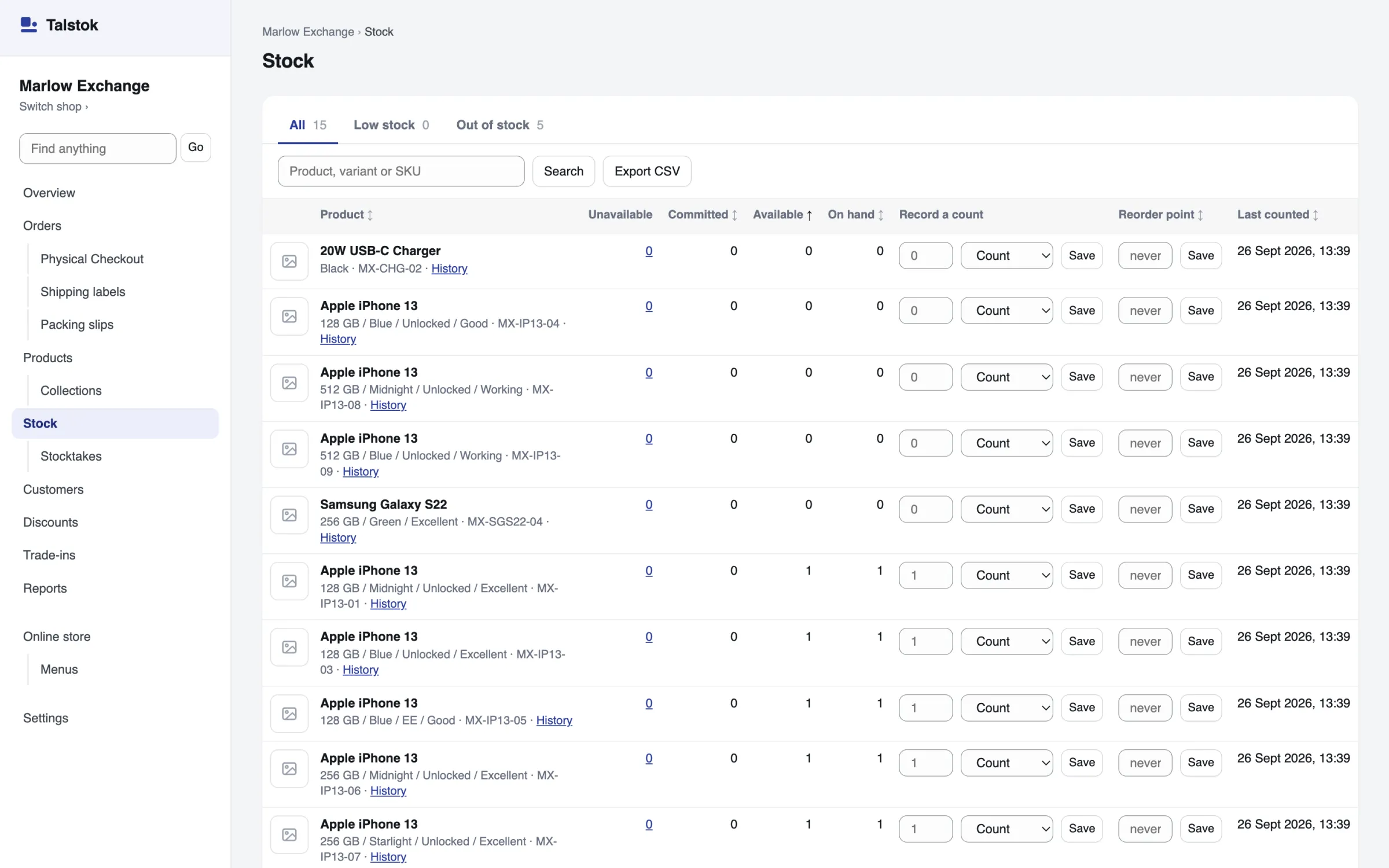
Talstok, which we make, is one option. This is what its stock control does today:
- One count per item, shared by the till and the online shop, with the history of every change.
- Stocktakes: count the shelf, enter the numbers, and the difference is saved with the stocktake.
- A low-stock level for each item, and a count on the overview of how many have fallen to it.
- Suppliers and purchase orders, with each delivery received against its order.
- Batches with their best-before dates and a recall list. When an online order is packed, the oldest batch is offered first.
- Items kept one by one by serial number or IMEI, each with its own price, facts and photos.
- Bundles made up of items you already stock.
Not built yet: several stock locations under one shop and transfers between them, low-stock emails, and selling a bundle, or a product that needs a batch number, at the till (both sell online).
Coming, as an option for some kinds of shop: an order emailed to the supplier automatically when an item falls to its reorder point. Today you raise each purchase order and send it to the supplier yourself.
How we wrote it. Written by the team that makes Talstok, retail software for UK shops. Where Talstok is the example, it is described as it works on 5 October 2026.